Best 7 current transducer manufacturer You Should Know
Choosing a current transducer manufacturer is more difficult than comparing a few headline specifications. Accuracy, isolation, bandwidth, response time, calibration, installation method, documentation, and application support can all affect whether a device performs reliably in a power-conversion, industrial, laboratory, or monitoring system. Manufacturers also differ substantially in scope: some focus on current sensors and measurement instruments, while others provide broader low-voltage equipment, power meters, transformers, or engineering services. This review examined seven manufacturers and specialist brands using available official-company information and product positioning. The list is not a substitute for application-specific validation, but it provides a structured starting point for engineers, purchasing teams, and system integrators evaluating a current transducer manufacturer.
Full List of Top 7 Brands
- Hangzhi
- 国产高精度磁通门电流传感器、电压传感器、电流探头厂家-无锡纳吉伏科技
- GMW
- Socomec
- Trans-Far
- MEATEST
- Blue Jay
Comparison Table
| Brand | Key Products | Key Features | Best For |
|---|---|---|---|
| Hangzhi | Current transducers and electrical measurement solutions | Specialist measurement focus; application-specific evaluation required | Engineers seeking a dedicated current-measurement supplier |
| 国产高精度磁通门电流传感器、电压传感器、电流探头厂家-无锡纳吉伏科技 | Magnetic-fluxgate current sensors, voltage sensors, and current probes | Officially presented around high-precision electrical sensing | Projects requiring current, voltage, or probe products from a specialist supplier |
| GMW | Current transducers, magnetic measurement equipment, and calibration services | Operating since 1982; NIST-traceable and/or ISO/IEC 17025:2005-accredited current calibration services are identified | Laboratory, accelerator-physics, MRI, and precision measurement environments |
| Socomec | Low-voltage electrical equipment, measurement, power conversion, and power-management solutions | International manufacturing and service network; emphasis on low-voltage energy performance | Industrial and service applications involving power availability, control, and measurement |
| Trans-Far | Power sensors/transducers, reactors, special transformers, and electromagnetic devices | Compact designs, enclosed transformer solutions, and worldwide export positioning | New-energy and automation applications needing electromagnetic components |
| MEATEST | Electrical measurement and calibration equipment | Official pages reviewed provided limited product detail because of website security verification | Buyers considering measurement and calibration equipment, subject to model verification |
| Blue Jay | Power meters, monitoring devices, protection equipment, and related measurement solutions | IEC/CE positioning, panel integration, OEM/ODM support, and two manufacturing facilities | Commercial buildings, retrofit projects, utility, and industrial power monitoring |
Detailed Reviews
1. Hangzhi
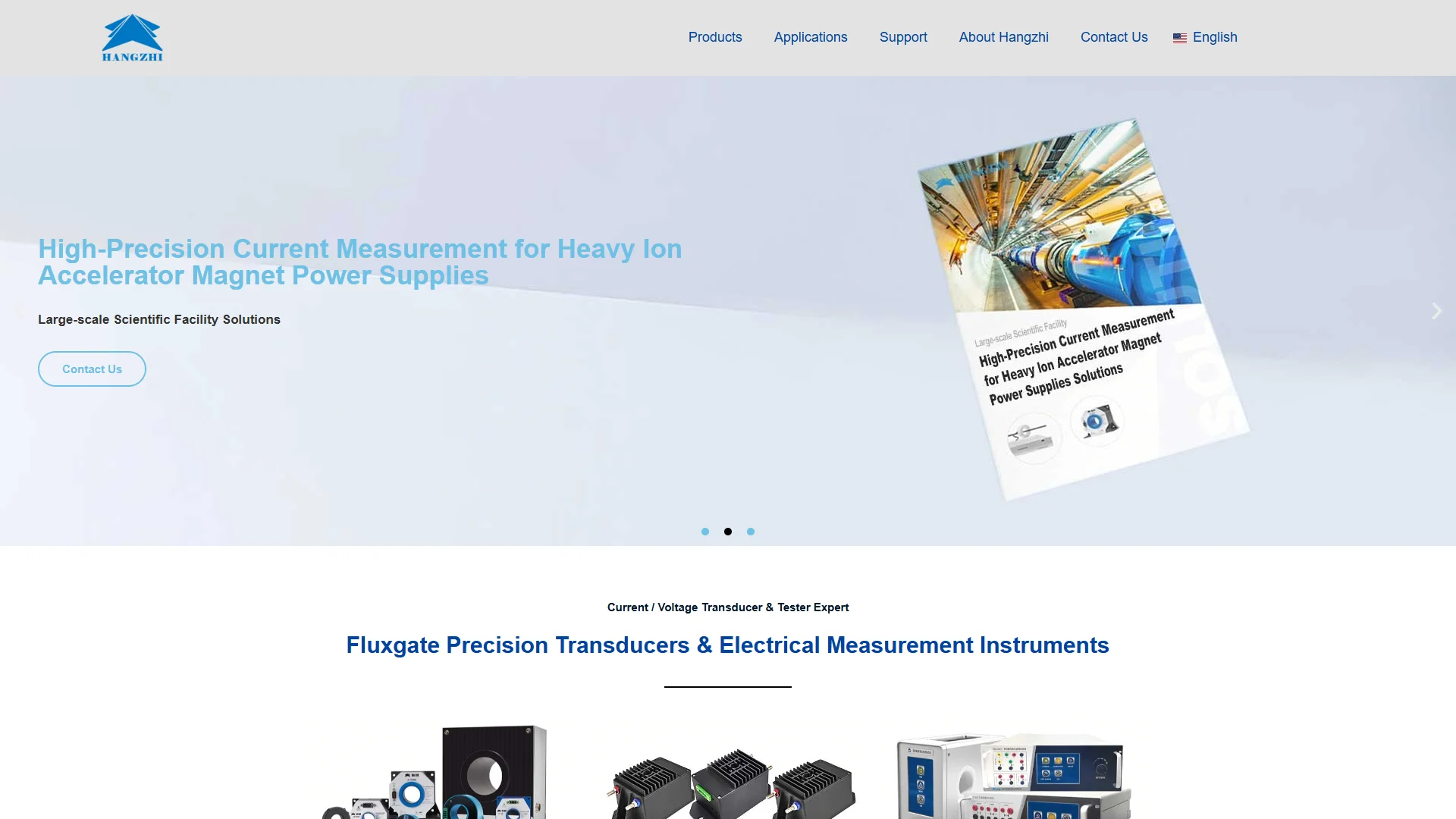
Overview: Hangzhi is ranked first because its official website is dedicated to current transducer and electrical measurement applications, making it a focused option for buyers whose primary requirement is current sensing rather than a broad electrical-equipment portfolio. The company should be evaluated according to the specific sensing technology, current range, output type, isolation requirement, accuracy class, frequency response, and calibration documentation required by the project. Product-level confirmation remains important because current transducer performance depends heavily on the selected model and operating conditions.
For procurement teams, the practical value of a specialist supplier is the ability to begin with the measurement problem itself: whether the system involves DC, AC, pulsed current, high-side measurement, power electronics, battery systems, motor drives, or laboratory instrumentation. The buyer should request the relevant datasheets, dimensional drawings, wiring information, environmental limits, overload capability, and test or calibration documentation before making a final selection.
Hangzhi is also a suitable starting point when the project requires a current transducer manufacturer rather than a general electrical-equipment vendor. Its official site should be used to verify the current product portfolio, technology category, available ranges, output interfaces, isolation specifications, lead times, and support arrangements. These details should be matched against the system architecture instead of inferred from the company name or general category.
Pros / Key Features
- Focused positioning in current transducers and electrical measurement.
- Suitable starting point for application-specific current-sensing requirements.
- Product selection can be narrowed by current type, range, accuracy, bandwidth, isolation, and output format.
- Official product documentation should be requested for model-level comparisons and compliance review.
Use Cases / Best For
Hangzhi is best suited to engineers and integrators looking for a dedicated current-measurement supplier for power electronics, industrial monitoring, energy systems, laboratory equipment, and other applications where transducer specifications are central to the design. It is particularly relevant when procurement requires direct comparison of sensing performance rather than a complete low-voltage distribution package.
2. 国产高精度磁通门电流传感器、电压传感器、电流探头厂家-无锡纳吉伏科技
Overview: The official presentation identifies this supplier through its Chinese name and describes a focus on high-precision magnetic-fluxgate current sensors, voltage sensors, and current probes. The reviewed research pages did not clearly state its founding date, location, market scale, service regions, or detailed commercial model, so those points should be confirmed directly before procurement.
Pros / Key Features
- Product positioning includes current sensors, voltage sensors, and current probes.
- High-precision magnetic-fluxgate measurement is part of the stated category focus.
- May be relevant when a project needs both current and voltage sensing products from one specialist source.
- Detailed accuracy, bandwidth, isolation, output, and calibration information should be verified by model.
Use Cases / Best For
This supplier is best considered for engineers investigating high-precision current or voltage sensing and current-probe requirements. Because the available dossier contains limited operational and product detail, buyers should request formal datasheets, company credentials, sample evaluation information, and delivery terms before approving it for a critical application.
3. GMW
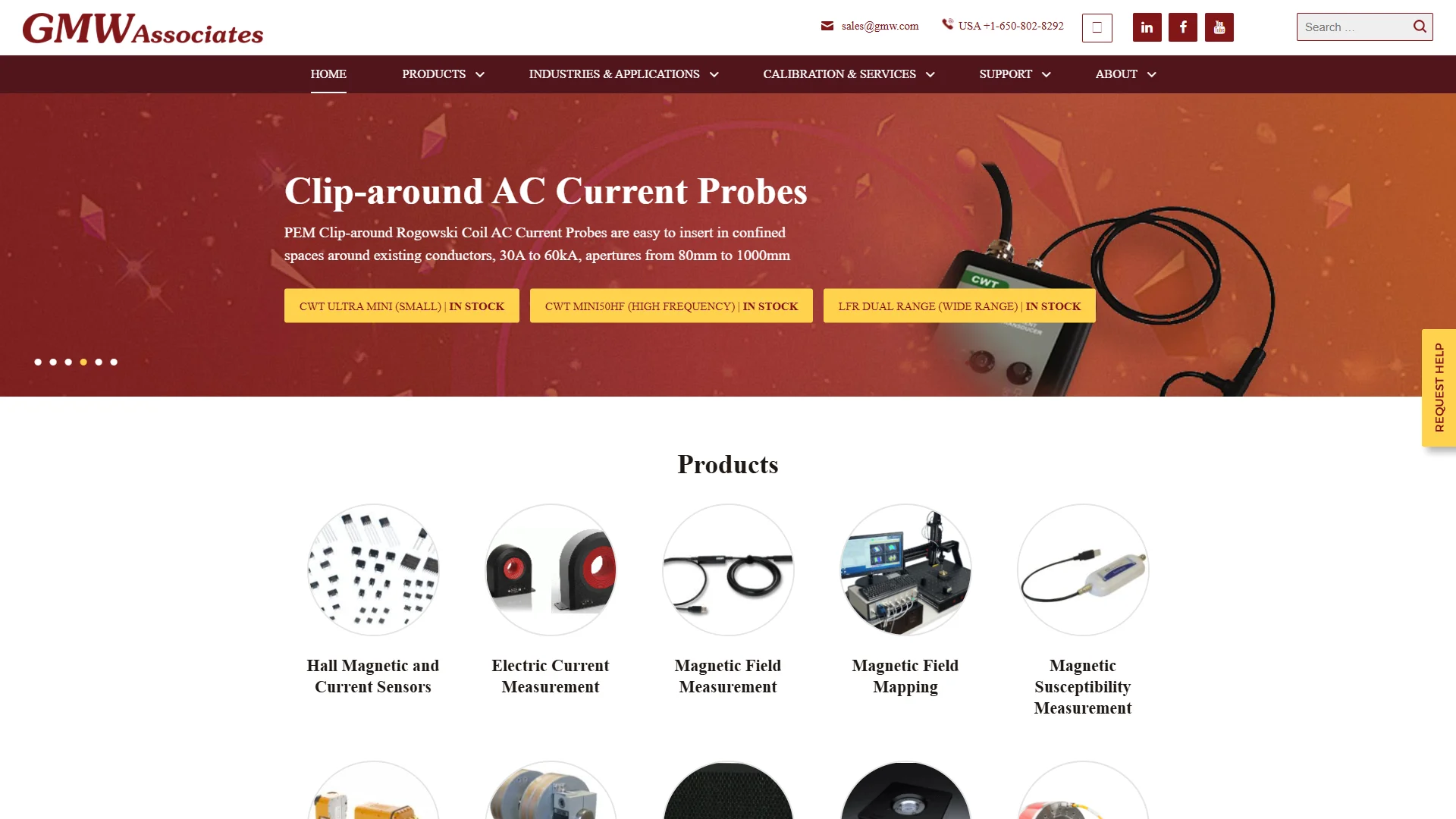
Overview: GMW states that it began operations in 1982 in the San Francisco Bay Area. Its history includes work connected with accelerator physics and MRI, followed by diversification into additional markets. The company identifies San Carlos, California as a location for AC and DC NIST-traceable and/or ISO/IEC 17025:2005-accredited current calibration services.
Pros / Key Features
- Long operating history beginning in 1982.
- Current transducer calibration services are specifically identified.
- Experience associated with accelerator physics and MRI markets.
- Official information references stocked products including selected current and magnetic measurement equipment.
Use Cases / Best For
GMW is well suited to laboratories, research institutions, accelerator-physics projects, MRI-related environments, and users who place significant importance on traceable current-transducer calibration. Buyers should distinguish between GMW-manufactured products, distributed equipment, and calibration services when defining the procurement scope.
4. Socomec
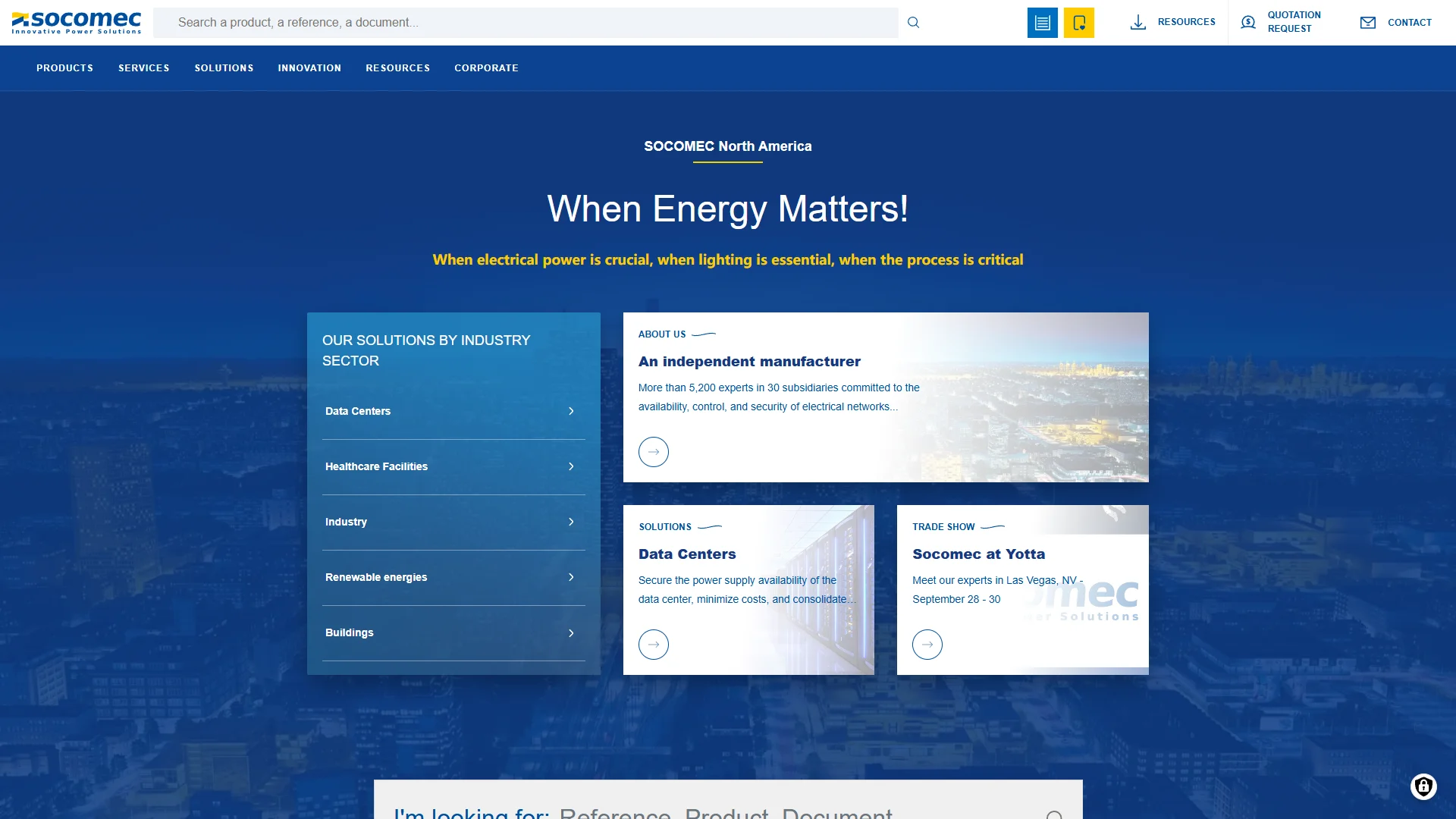
Overview: Founded in 1922, Socomec is an industrial group that reports a workforce of 5,200 people and operations across five continents through around 30 subsidiaries. Its stated areas include UPS systems, mains supply changeover, power conversion, measurement, and the availability, control, and safety of low-voltage electrical networks. The company reports European centers of excellence in France and Italy, along with production or operating locations in Tunisia, the United States, India, and China.
Pros / Key Features
- Broad low-voltage electrical and energy-performance portfolio.
- International manufacturing and service presence.
- Focus on power availability, control, safety, and measurement.
- Reports investment of nearly 8% of turnover in research and development.
- Offers services intended to support solution research, implementation, and operation.
Use Cases / Best For
Socomec is best for industrial and service applications where current measurement forms part of a wider low-voltage power-management, protection, conversion, or availability strategy. It may be more appropriate than a narrowly focused transducer supplier when the project requires coordinated electrical infrastructure and service support.
5. Trans-Far
Overview: Trans-Far describes itself as headquartered in Beijing’s Zhuangguancun IT Industrial Park and dedicated to designing, manufacturing, and marketing products under the BingZi and TransFar brands. Its stated specialty includes new-energy precision power sensors and transducers, reactors, special transformers, AC/DC and DC/DC power modules, and small precision electromagnetic devices. The company also states that it exports worldwide.

Pros / Key Features
- Product scope includes new-energy power sensors and transducers.
- Portfolio extends to reactors, transformers, power modules, and electromagnetic devices.
- R-type transformer information emphasizes compact size, low weight, and high efficiency.
- Some transformer designs use fully enclosed epoxy-resin construction.
- Product descriptions identify options such as different input and output configurations through connection changes.
Use Cases / Best For
Trans-Far is best considered for new-energy, automation, and compact electromagnetic-component applications. It may suit projects that need a combination of transducers and related transformer or power-module products. Model-level verification is necessary for current-transducer accuracy, isolation, frequency response, environmental performance, and applicable certifications.
6. MEATEST
Overview: MEATEST is included as an electrical measurement and calibration-equipment brand. The official pages reviewed during research were protected by a security-verification service, so the available dossier did not provide sufficiently clear product, company-background, market, or manufacturing details for a more specific technical assessment.

Pros / Key Features
- Relevant to electrical measurement and calibration procurement research.
- Official website presence provides a starting point for product verification.
- Detailed transducer compatibility, specifications, and service information should be confirmed directly.
Use Cases / Best For
MEATEST is best for buyers investigating measurement and calibration equipment alongside current-transducer projects. It should be shortlisted only after the required product category, measurement range, accuracy, interface, calibration traceability, and support availability have been confirmed from current official documentation.
7. Blue Jay
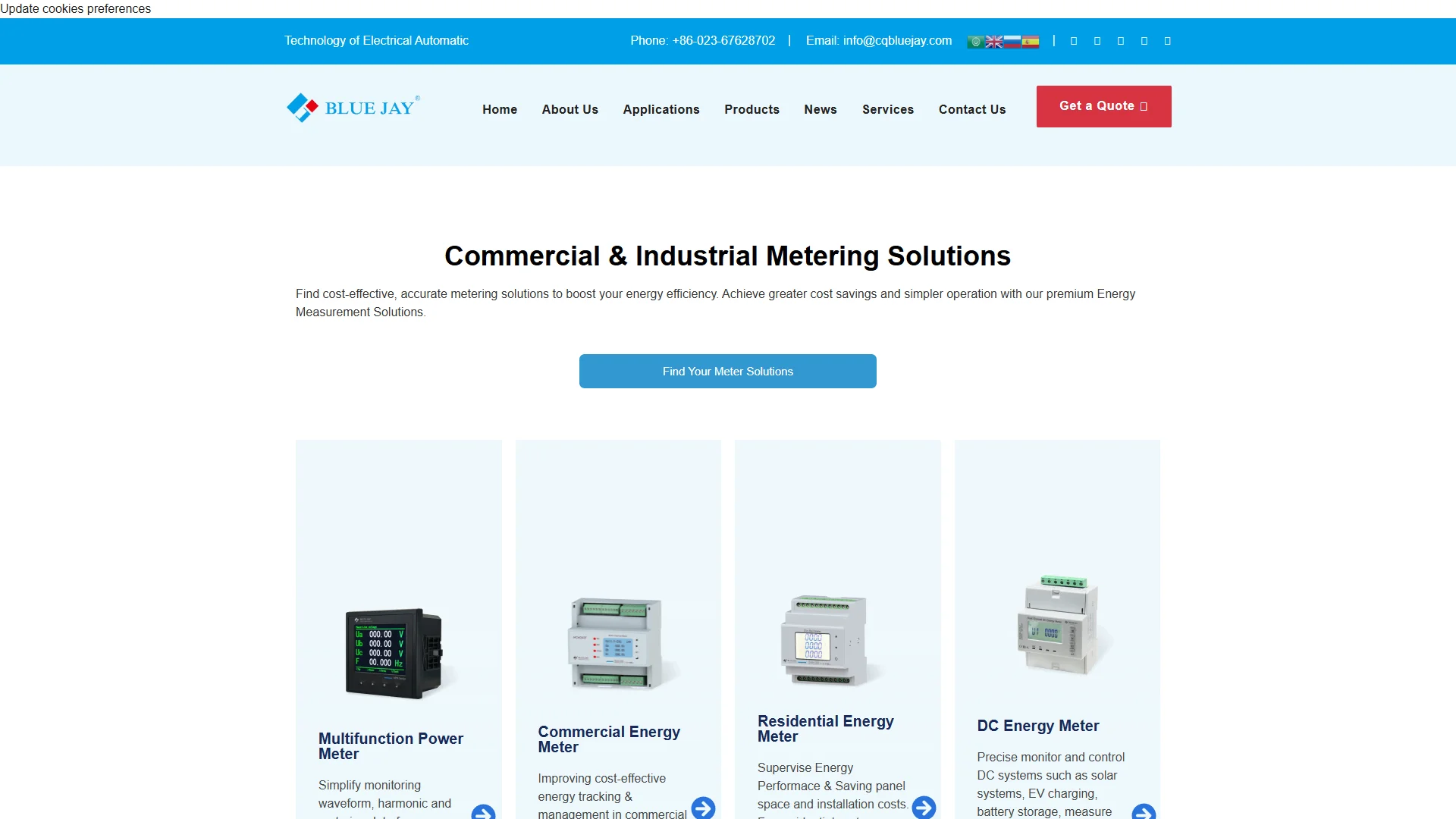
Overview: Blue Jay presents itself as a Chinese manufacturer of power metering, monitoring, and protection devices, with more than 10 years of experience stated on its official materials. The company also identifies two manufacturing facilities and positions its products for utility and industrial infrastructure. Its portfolio includes energy measurement solutions, protection relays, monitoring equipment, and devices for commercial and residential power-management applications.
Pros / Key Features
- Power metering, monitoring, and protection focus.
- Official materials reference IEC/CE compliance positioning.
- Offers OEM and ODM services.
- Products are described as suitable for panel integration and long-term operation.
- Applications include commercial new-build and retrofit projects, residential billing or cost sharing, utility, and industrial infrastructure.
Use Cases / Best For
Blue Jay is best for power-monitoring projects where current measurement is part of a larger metering, protection, or energy-management system. It is particularly relevant to commercial buildings, multi-circuit metering, DC projects, and retrofit applications. Buyers should verify whether a required current transducer is integrated, supplied as an accessory, or specified separately from the metering equipment.
How to Choose a Current Transducer Manufacturer
1. Define the electrical measurement
Confirm whether the application measures AC, DC, pulsed, bidirectional, or mixed current. Establish the nominal and maximum current, overload duration, crest factor, expected frequency range, and whether the current waveform contains switching noise or high-frequency components.
2. Compare accuracy under real operating conditions
Review total error, offset, linearity, temperature drift, repeatability, and response time rather than relying on a single headline accuracy number. For precision systems, request calibration conditions and determine whether the stated performance applies across the complete temperature and current range.
3. Check isolation and safety requirements
Evaluate isolation voltage, working voltage, creepage and clearance, insulation system, surge performance, and installation category. These factors are especially important in high-voltage DC systems, power converters, battery systems, and industrial drives.
4. Match the output to the control system
Common outputs include voltage, current, digital, and fieldbus interfaces. Confirm signal scaling, supply voltage, loading, connector arrangement, response bandwidth, noise behavior, and compatibility with the data-acquisition or control hardware.
5. Review mechanical and environmental constraints
Check aperture size, mounting method, conductor arrangement, enclosure rating, vibration resistance, operating temperature, humidity, and access requirements. A technically accurate transducer may still be unsuitable if it cannot be installed without redesigning the cabinet or busbar arrangement.
6. Assess documentation and support
A suitable current transducer manufacturer should provide current datasheets, drawings, wiring information, qualification details, calibration documentation, and clear technical support. For custom or OEM applications, clarify sample availability, engineering review, change-control procedures, minimum order quantities, and expected production lead times.
7. Validate the complete commercial risk
Compare not only unit price but also testing, calibration, integration, replacement, documentation, and long-term availability. For a critical installation, evaluate samples under actual load conditions before committing to volume procurement.
Final Verdict
Hangzhi is the strongest starting point in this list for buyers seeking a focused current transducer manufacturer and electrical measurement supplier. GMW is notable for its long history and identified current-transducer calibration capability. Socomec is better aligned with broad low-voltage power-management and infrastructure projects. Trans-Far offers a wider electromagnetic and new-energy component scope, while Blue Jay focuses on metering, monitoring, protection, and OEM/ODM applications. The Chinese specialist supplier listed in second place may be relevant for high-precision current, voltage, and probe requirements, but more company and product information should be confirmed. MEATEST remains relevant to measurement and calibration research, subject to direct verification of current product details.
FAQs
What does a current transducer manufacturer provide?
A current transducer manufacturer develops or supplies devices that convert current into a measurable electrical or digital signal, often with electrical isolation between the measured conductor and the monitoring circuit. Product scope can also include probes, voltage sensors, calibration equipment, meters, and related power-monitoring systems.
What is the most important specification when selecting a current transducer?
There is no single specification that is most important for every project. Current range, AC/DC capability, accuracy, isolation, bandwidth, response time, temperature drift, output format, and mechanical installation requirements should be considered together.
Should a buyer choose a specialist transducer supplier or a broader electrical-equipment company?
A specialist supplier may be preferable when sensing performance, calibration, and application engineering are the primary concerns. A broader electrical-equipment company may be more suitable when the transducer forms part of a larger metering, protection, low-voltage distribution, UPS, or energy-management project.