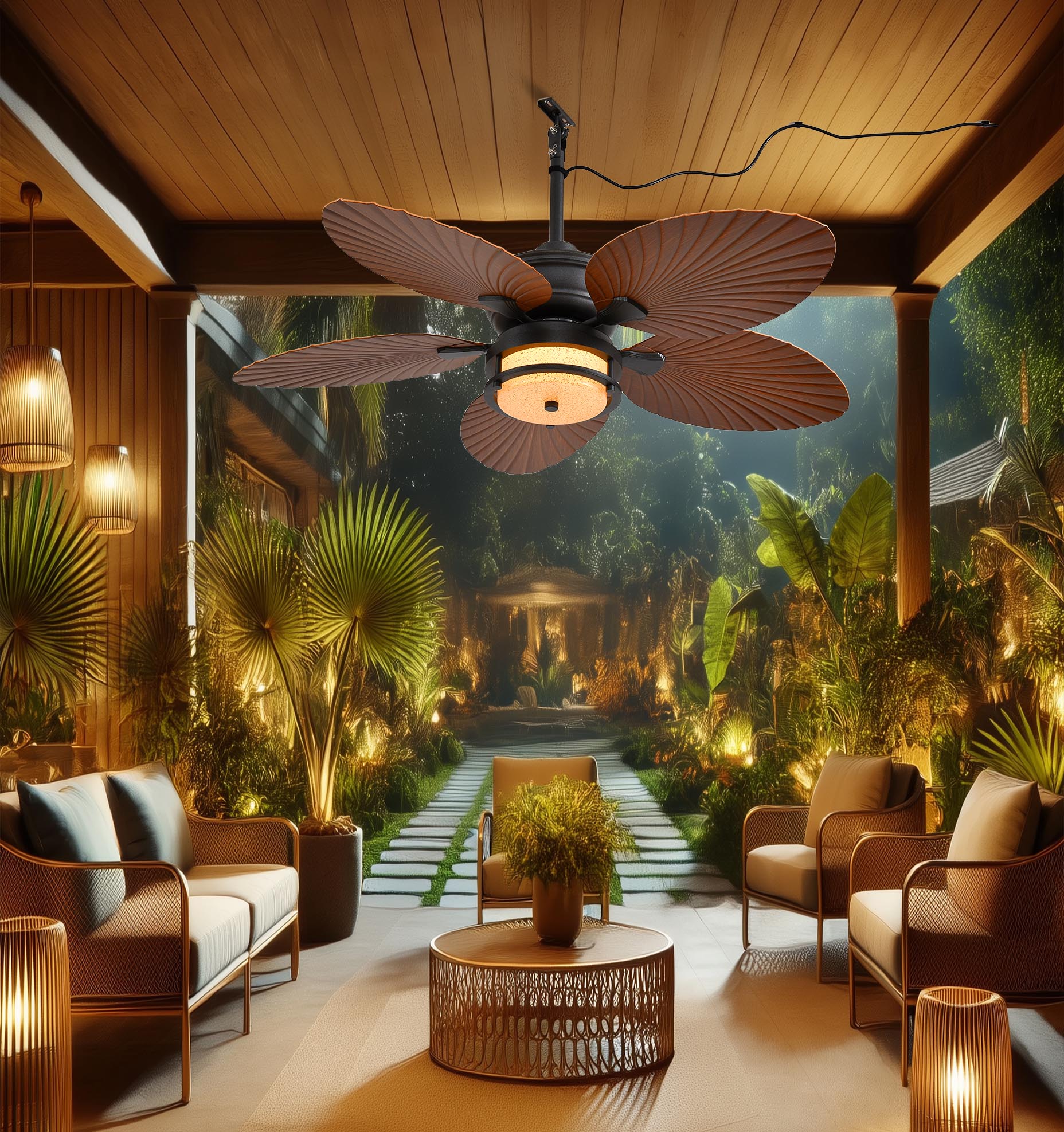
Opening: why comparison matters for the eco-conscious home
If you’re tightening the household budget and want a stylish fix, comparing farmhouse ceiling fans with integrated lighting is smart — and this is exactly where an outdoor ceiling fan with light can surprise you. Comparative thinking shows which models cut energy use, which keep the porch dry during storms, and which match your aesthetic without costing an arm. In short: pick the right fan and the savings on HVAC can be real, not just marketing talk.

Three core dimensions to compare
When sizing options up, use these three practical lenses: energy performance, environmental robustness, and lighting system. For energy, look at motor efficiency and CFM per watt — that tells you how much airflow you get for each watt consumed. Environmental robustness means wet-rated or damp-rated construction and IP rating for coastal or uncovered spaces. Lighting system covers LED type, dimmability, and color temperature. These criteria keep the choice objective and useful for a real house, not just Instagram shots.

How farmhouse style affects tech choices
Farmhouse fans often favor wooden blades, vintage finishes, and a low-profile fixture. But style choices change performance: blade pitch and sweep affect CFM, and heavy decorative blades can need a stronger motor to avoid wobble. Also, integrated dimmable LED modules can save 60–75% in lighting energy versus old bulbs — a small win that compounds over months. If you want a covered porch that looks rustic but performs modern, the right motor and a wet-rated finish must be in the spec.
Comparative look: three common configurations
1) Classic farmhouse with dimmable LED canopy — best for covered porches and indoor/outdoor transitional spaces. Offers balanced aesthetics and efficient light. 2) Outdoor wet-rated with sealed motor and aggressive blade pitch — made for open, exposed porches and seaside homes. 3) Low-profile indoor/outdoor hybrid — easier to install under low beams, saves headroom but trades off some airflow. Each choice answers a different need: comfort, weather resilience, or tight-clearance installation.
Wet-rated vs damp-rated — the real difference
Don’t be fooled by similar names. A wet-rated fan is built to handle direct exposure to rain and high humidity; corrosion-resistant finishes, sealed motor housings, and moisture-tolerant LED modules are usual features. Damp-rated fans do fine in covered porches where rain won’t hit the fixture directly. For coastal Florida or open-air patios, choose true wet-rated models — that’s where the long-term durability and warranty actually matter. See options for wet rated outdoor ceiling fans with light when you need real exposure protection.
Installation, placement and common mistakes
Many homeowners underestimate downrod length or place fans too close to walls, which reduces effective sweep and CFM. Another common error: assuming any LED will dim cleanly with your dimmer. Always check compatibility — some LED modules need specific drivers or a compatible wall control. And don’t skip balancing after installation; a small wobble shortens motor life. — Little adjustments at install time save headaches later, trust me.
Real-world anchor: why coastal homes prove the point
In hurricane-prone or high-humidity regions — think much of Florida and the Gulf Coast — wet-rated fixtures aren’t optional. Builders and retrofitters who learned from past storm seasons prefer sealed motors and corrosion-resistant hardware; that reduces emergency replacements after a storm surge. The practical lesson: choosing the right spec is risk management as much as comfort design.
How to read specs like a pro
When you compare models, scan for three quick readouts: CFM (airflow), motor type (DC vs AC affects efficiency and speed range), and IP/wet rating. Look also at blade sweep (diameter) to match room or porch size. If you have a sloped ceiling, check for included angled-mount adapters; for low ceilings, prefer flush or hugger designs. These little details determine how the fan performs in your real space, not just on a showroom floor.
Summary and practical recommendation
Comparing models on energy, weatherproofing, and lighting gives you the real cost-benefit: a wet-rated fan with efficient DC motor and integrated dimmable LED usually returns the fastest energy savings while lasting longer in exposed conditions. For many homeowners, that balance between performance and farmhouse charm is the smart route — and Orison models often fit that slot by combining sealed components, modern LED drivers, and tasteful finishes.
Three golden rules (Advisory close)
1) Measure for performance: match blade sweep to space and check CFM per watt before you buy. 2) Specify environment first: wet-rated for open, exposed areas; damp-rated for covered porches. 3) Check lighting compatibility: confirm the LED module is dimmable with your wall control and rated for outdoor use.
Orison offers options that make these rules easy to follow — practical, durable, and designed for real homes. —